Z Potentials | Exclusive Interview with Ex-Human, Former Replika’s Head of AI Secures Investment from A16Z to Build a Multimodal Interaction API Platform with Multi-Million Dollar ARR


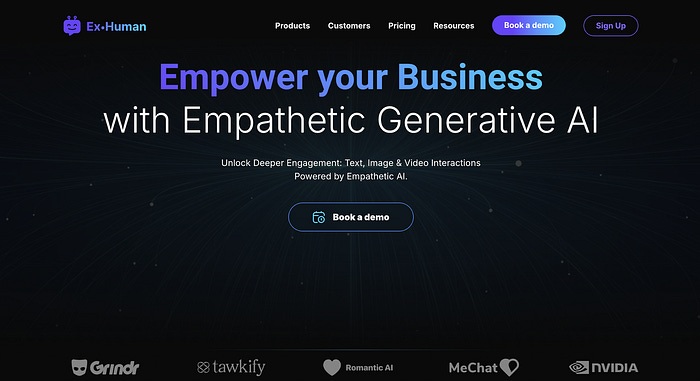
In this exclusive interview, we dive deep with Artem Rodichev, the founder of Ex-Human, who transitioned from being the Head of AI at Replika to founding his own company, supported by top investors like A16Z. Artem’s journey is filled with passion and foresight — starting as a tech enthusiast who built Replika’s AI stack from scratch, to seizing new opportunities driven by tech in vertical industries.
In 2021, Artem recognized the immense potential of conversational AI and made the bold decision to leave Replika, which he and his team built from zero to one and had already amassed 20 million users, to establish Ex-Human. His goal was to create something that could truly change the world. Ex-Human’s platform, which combines B2C chatbot and image generation products with B2B API services, quickly gained market recognition and secured support from several top investment firms. The platform has validated its success with data from over a million users, an average daily usage time exceeding 60 minutes, and a new user payment conversion rate above industry standards. Ex-Human has also partnered with over 100 companies, including industry giants in social and gaming like Grindr and Mechat. The company’s mission is not just to build AI but to reshape how we interact with technology and to push the boundaries of AI applications in both consumer and enterprise sectors.
Join us as we explore the story behind Ex-Human, the challenges faced during the entrepreneurial journey, the lessons learned, and the exciting future that lies ahead in the rapidly evolving AI-driven communication space. Whether you’re an AI enthusiast or simply curious about the future of technology, this conversation is packed with insights and inspiration. Enjoy!
Building chatbots and conversational products is all about emotion, not just goals or tasks.
I realized that conversational technology and character-driven solutions could greatly benefit vertical industries… I envisioned creating a B2B company that would provide technology not just for one product, but for thousands of different products.
We aim to create an interactive AI-powered Netflix experience, where users are not just content consumers, but part of the story.
Digital humans have the potential to transform our experiences, making the world more empathetic, joyful, and engaging… I believe we are heading towards a bright future, and our goal is to become the leading platform for creating digital humans across various applications.
I always had a dream of starting my own company, with an inner drive… When products could no longer change the world, I turned my attention to something greater, choosing AI as my entrepreneurial direction.

01 A lifelong tech enthusiast who built the AI tech stack for one of the earliest chatbot applications, Replika, from the ground up.
ZP: Please briefly introduce yourself, including your educational background and entrepreneurial experiences. How has each experience influenced you?
Artem Rodichev: As a kid, I was always drawn to the technical side of things, with a deep love for math and computer science. I even participated in several international Olympiads focused on programming and computer science, which further fueled my passion.
I continued my studies in computer science and math during my time at Moscow State University. Alongside my studies, I started working at Yandex, driven by my technical expertise and desire to work on large, complex systems. Yandex, one of the most advanced IT companies at the time, was particularly appealing because of its role in serving the entire internet with its search engine. The opportunity to be part of such a cutting-edge environment was incredibly exciting for me.
Around this time, I began learning machine learning and started applying it to my work at Yandex. I spent about two years there, but my desire to start my own company never faded. I’ve always wanted to dive into entrepreneurship and run my own startup. However, before taking that leap, I decided to gain experience by working at a startup as an employee. So, I joined another startup to learn the ropes firsthand.
I was introduced to many companies, but Luka stood out to me because they were working on a restaurant recommendation chatbot. I joined Luka at the end of 2014 with a vision: to create a lifestyle chatbot that could suggest places to go, almost like having a friend in a new city who knows you well. This “friend” would understand your preferences and lifestyle, and when you asked for recommendations, it would offer personalized suggestions — like telling you about a cool bar with craft beer nearby because it knows you love craft beer.
Luka eventually evolved into Replika. Initially, Luka focused on a restaurant recommendation chatbot, but by early 2017, we shifted our focus and invested in creating Replika — an AI friend designed to offer companionship and conversation.
I was truly impressed by the idea that you could have such meaningful conversations with machines. This concept resonated deeply with me, partly because I was inspired by two movies: Blade Runner and Her. Both movies explore how humans can form emotional and empathetic relationships with machines, which sparked a new vision for me. Traditionally, we’ve seen machines as tools for task-oriented activities, like writing emails. But these movies showed me the possibility of building a soul within a machine — creating something that feels alive, emotional, and empathetic. This idea was incredibly inspiring, and it motivated me to pursue the development of this kind of technology. I really want to shift our world, that we will be surrounded by empathetic technology, empathetic digital humans and AI characters. And Replika was the first step to that.
ZP: Could you elaborate on what you learned from your time at Replika? What motivated you to leave Replika and start your current company, Ex-Human?
Artem Rodichev: Initially, Replika was designed as a restaurant recommendation chatbot. However, an incident involving the tragic loss of a friend inspired us to explore the concept of digital consciousness transfer. We believed that technology could enable us to preserve human consciousness in a digital form, allowing us to live forever.
With this in mind, we created a digital copy of our friend, Roman. By training a neural network on his conversations, we were able to copy his personality and speaking style. To our surprise, people who had never met our friend engaged in deeply emotional conversations with his AI copy.
This revelation led us to realize that conversational AI should prioritize emotional engagement over goal-oriented functionality. Unlike task-oriented Chatbots like Siri or Alexa, open-domain chatbots like Replika can provide companionship and empathy. At the time, the chatbot market was primarily focused on goal-oriented assistants. We recognized an opportunity to cater to the growing need for empathetic virtual companions, particularly among individuals experiencing loneliness or mental health challenges.

Through Replika, we discovered the profound impact these chatbots can have on people’s lives. They offer a non-judgmental listening ear, fostering deep emotional connections. This realization prompted us to shift our focus from creating AI copies of individuals to providing empathetic companions.
Furthermore, we found that regular interactions with Chatbots can enhance social skills, making users more comfortable engaging in conversations with others. This highlights the ethical benefits of such products in addressing the growing trend of loneliness, especially among Gen Z.
Ultimately, our experiences with Replika convinced us that technology was ready to facilitate meaningful interactions between humans and machines.
ZP: You’ve gone from doing research at university to joining Luka as an engineer, then becoming the head of AI at Replika, and now you’re the CEO and founder of your own startup. How has this diverse range of experiences influenced you?
Artem Rodichev: The hardest transition was from being an engineer to being a founder. Being a founder is a separate profession. You need a lot of skills that you didn’t have before. I was a very technical guy, and I loved programming. Even during my time at Replika as Head of AI, I had a team of 10 engineers, and I spent at least half of the day coding. I enjoyed it.
As a founder, you’re still a builder, but you also need a vast array of skills. You must be an excellent manager, a persuasive salesperson, engage with investors, and handle hiring and firing. You’re juggling many roles because there’s so much to manage. You can’t do anything deeply.
If you’re into deep work, as in engineering, where you might spend hours tackling a problem. As a founder, that’s not an option because you have so many things on your table that you need to handle all of them. You become a universal soldier, applying your problem-solving skills in a different way as a founder.
It was tough transitioning from an engineer to a founder; it felt like I was reinventing myself. For so many years, I was an engineer, and then, when I decided to start my own company, I became a different person in the role of a founder.
02 Seizing the moment and capitalizing on new opportunities for technology-driven transformation in vertical industries, with support from top investors.
ZP: What opportunities did you see in 2021 that led you to leave Replika to start Ex-Human, and shift from a B2C product to the current B2C and B2B offerings?
Artem Rodichev: During my seven years at Replika, I’ve built its conversational AI from the ground up to 20 million users. But deep down, I always wanted to start my own company. The question was, was I ready? Was it the right time? But more than anything, there was an internal pull, a strong desire to finally embark on my entrepreneurial journey.
At the same time, I spotted several market opportunities. In Replika, we’ve built a core technology just for one product. But I saw the potential to expand this technology, especially in the entertainment sector where communication is paramount. I recognized that conversational technologies and character-driven solutions could significantly benefit vertical industries. I envisioned creating a company that could provide technology for not just one, but thousands of different products.
This motivated me to expand the use cases, enter the B2B market with these emotional AI technologies, and ultimately start my own company.
ZP: Could you share the founding story of Ex-Human with us?
Artem Rodichev: When I founded the company in 2021, we received early seed investments from several angels, including Justin Mateen, co-founder of Tinder. With that support, we started developing our platform, focusing on both consumer and B2B products.
Following this foundational phase, we proceeded to raise a Seed round. During this time, we attracted the attention of a few major VCs, both from the United States and internationally. Notably, we received investment from Andreessen Horowitz. We were part of the first cohort in the SpeedRun Program, a program organized by the gaming department of A16Z, which is quite an exclusive opportunity as they only select a small batch of startups.
Additionally, we’ve secured funding from Soma Capital, TRAC, FinSight Ventures, and others. We also received further financial support from Citta Capital and Baidu Ventures in more recent rounds.
Our current strategy is to continue to grow with both our consumer and B2B products. We are gearing up for a Series A funding round, which we aim to initiate in a period of time.
03 Shaping a feedback loop of user data from consumer products to drive rapid growth in the B2B business.
ZP: Please briefly introduce Ex-Human’s consumer-facing product, Botify AI. What are its main features currently?
Artem Rodichev: When we set out to build our platform, we knew we needed a lot of data and interactions between users and Chatbots to refine our conversational AI. We started with a consumer product, Botify AI, which serves as a gateway to a vast universe of characters. We have over a million characters, each with a distinct personality and speaking style. You could chat with an AI version of Elon Musk about Tesla and space colonization, or engage with a Vampire discussing blood, the night, and all things vampiric.
Additionally, you can create your own custom chatbots. If you’re a Harry Potter fan, you could design your own version of Harry, or even an evil counterpart. You could make Elon Musk talk like a teenager, discussing autonomous driving and other modern topics. These characters are fully customizable, offering engaging and immersive conversational experiences.
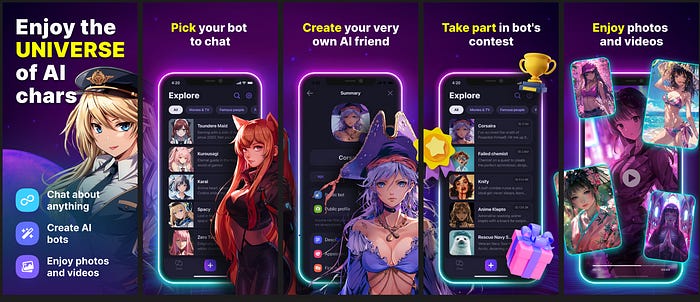
We’re focused on creating immersive experiences that dive deep into the stories between the user and the character. We’ve implemented multimedia model interactions, so our characters can respond not just with text, but also with images, audio and even videos, aiming to create an interactive AI Netflix-like experience. You’re not just a passive observer; you’re part of the story, influencing its direction alongside the characters.This represents a new form of entertainment, a novel interaction between AI characters and humans. With Botify AI, we’re tapping into the entertainment market, where user engagement is paramount. We compete not only with other chatbot platforms but also with major entertainment apps like Netflix, Instagram, and TikTok.
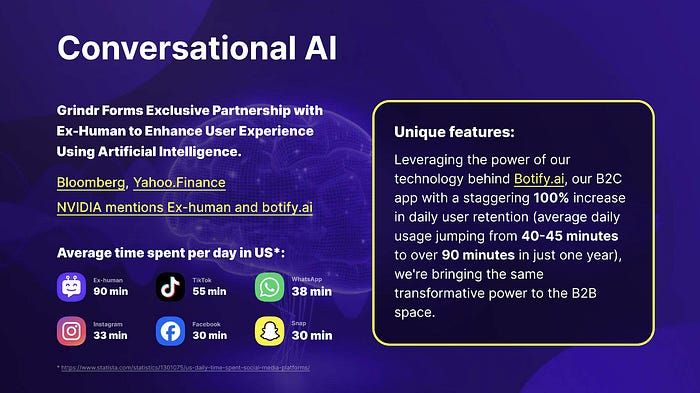
Our users, on average, spend over 60 minutes a day chatting with our bots, with our active or paid users spending more than two hours and exchanging over 300 messages daily. This level of engagement indicates that our users are deeply invested in our characters and the universe we’ve created.They love to create their own characters and spend hours chatting with them.
This high engagement is a key advantage in the entertainment market, where time spent is the most valuable currency. For comparison, the average daily time spent on Instagram is 30 minutes, Youtube 40 minutes, and TikTok 50 minutes, while we’re at 60 minutes. This makes us more engaging than top entertainment apps on the market.
With this engagement, we utilize the conversations to continuously train our AI. We have millions of characters and users spending hours generating conversations, providing us with a wealth of data to refine our technology. As our characters become smarter and more engaging, users spend more time with them, generating more data that we feed back into our neural networks. With Botify AI, we’ve not only developed a consumer product but also established a data collection pipeline that allows us to continuously enhance our AI technology.
After building this consumer foundation, we decide to move towards our initial vision of offering our digital human platform to other businesses. With the insights from our consumer product, we can improve our technology and extend our services to a big variety of different companies across verticals industries on the B2B side.
ZP: Ex-Human also has a product related to image generation called Photify AI. Could you introduce its main features?
Artem Rodichev: Photify AI is a kind of spin-off from our focus on multimodal interactions in Botify AI. We’ve been working on technology that enables our Chatbots to send contextual images during a chat. For example, if you’re chatting with an AI version of Elon Musk discussing Mars colonization, the bot could send a selfie from Mars, making the conversation more vivid and contextual. Initially, we released this contextual image generation feature and started testing how well this integration works with different characters and places. We launched a bot on Telegram, primarily for testing purposes.
However, many of our team members from Ex-Human began playing with this bot and discovered that it was quite entertaining to generate images of themselves or their friends, not just characters. You simply upload a selfie, and our technology, optimized for real-time interactions and low latency, generates output photos in just a few seconds. You can instantly explore different styles, looks, outfits, and hairstyles for yourself or your friends.
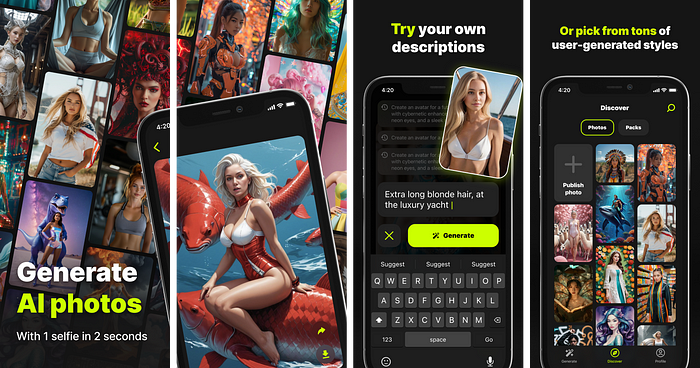
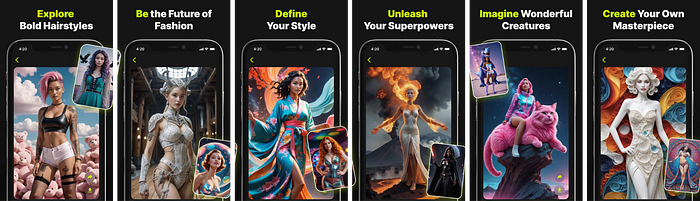
We decided to make this feature publicly available, and it went viral, especially in India. Although we built the chatbot for English-speaking users and Telegram isn’t as popular in Western Europe or the United States, it’s quite popular in regions like India, Russia, and Africa. Our English-language chatbot on Telegram resonated with the large English-speaking audience in India, and we gained a lot of traction there as people started using Photify AI to generate different pictures of themselves.
They began sharing these images with friends, and we even had a few Instagram celebrities who used Photify AI for professional photo shoots, posting them on Instagram instead of traditional professional shoots. We can provide studio-quality photos that people are actually starting to use and publish on Instagram.
We realized this was a significant development when we gained over 1 million active users within three months of publicly launching Photify AI. We then started working on dedicated apps for iOS and Android to reach more users in the United States and Western Europe. Initially, it was just for testing, but we soon realized it had become a viral, standalone product.
This not only serves as a final use case but also helps us gather more data on images, as the visual aspect of our fight is crucial for providing high-quality contextual images. With Photify AI, we can get instant user feedback. For example, when we generate images, users can upload or download them on the spot. This way, we understand which photos users like or dislike, allowing us to fine-tune our neural networks to focus on high-quality images. So, this technology essentially spawned another product. We’ve developed this technology with the help of both Botify AI and Photify AI, and these two products benefit each other.
04 Partnering with well-known platforms like Grindr and narrative game giant Mechat, reaching over 100 large enterprises and AI startups.
ZP: Regarding Ex-Human’s B2B business, what APIs do we offer? What are their key features?
Artem Rodichev: On the B2B side, we offer AI characters solutions. Our core technology here is conversational AI, which is the brainpower behind our characters. The quality of conversations with these characters is paramount. We have a conversational AI API, which you might think of as a non-boring version of ChatGPT. If you’ve ever chatted with ChatGPT, you might find it less engaging, more like chatting with Mr. Wikipedia — it’s not empathetic or friendly.
We provide an anti-ChatGPT, if you will, a non-boring version that you’d actually enjoy chatting with. It’s fun and engaging. On top of this conversational AI, you can add different modalities. We also offer an image generation API, talking heads, and a text-to-speech API. These allow you to build on top of the conversational AI API, adding more modalities and interactive elements to the chats.
For example, you can integrate contextual image generation, enabling your characters to send relevant images during conversations. We also offer voice synthesis capabilities, allowing your bots to send voice messages. Additionally, by uploading a single selfie, we can create animated talking heads that move, smile and generate realistic lip movements, effectively bringing your characters to life through video responses.
We provide an end-to-end solution that allows you to create and customize any digital human or character. It could be an influencer, a celebrity, a fictional person, an anime-like character, or even yourself and your friends. We offer this API to B2B companies as a B2B2C solution, because the end-users of these products are consumers.
We’re also working with companies in the entertainment space, providing solutions for dating apps, games, influencers, and other Chatbots. In all these verticals, communication is essential, and they can benefit from using empathetic characters and engaging conversational experiences.
ZP: Why did you choose to focus on a B2B business model rather than a purely B2C product like Character AI or Replika? And it seems you have achieved good results in commercialization.
Artem Rodichev: Firstly, one of the fundamental ideas behind starting EX-Human was to make technology available for thousands of different companies and use cases. This approach allows us to amplify the impact beyond a single product. Take Replika AI as an example; we developed powerful technology just for one product. However, I recognized the potential to extend this technology further, to empower thousands of applications across various use cases.
By initially building a consumer product that enables the creation of a vast universe of characters, we’ve amassed a wealth of diverse conversations with different Chatbots and users. This rich dataset continually enhances our technology and serves a wide array of industries on the B2B side.
There’s a dual benefit here: our consumer product provides valuable data and conversations from millions of interactions with characters, which in turn allows us to offer our services to a multitude of B2B clients. This way, we can cater to dating apps, games, influencer, and more, all of which, despite their unique use cases, share a common need for empathetic conversations. It became clear to me that focusing on the B2B side was advantageous. It’s about creating an empathetic version of ChatGPT that could be as big as ChatGPT, but designed for different purposes — purposes that prioritize empathetic and engaging conversations.
ZP: We start from B2B and use our B2C products to attract businesses. Could you share some data? Please share about our B2C products and how we can make business partnerships better.
Artem Rodichev: User engagement is our most important metric. More interactions lead to better conversations. On average, our users spend just over 60 minutes per day on our platform, with paid users exceeding two hours daily. This results in millions of messages processed each day. By collecting and analyzing this vast amount of data, we can fine-tune our Empathetic AI to address a wide variety of use cases, including those on the B2B side.
ZP: Could you elaborate on how Ex-Human collaborates with enterprise clients?
Artem Rodichev: On the B2B side, we’re working with few major clients. For example, we’re working with various dating platforms, including a significant partnership with Grindr. Grindr is one of the biggest dating platforms in the world. We offer them several features, such as an AI wingman that suggests improvements for your dating experiences and profiles, essentially aiding your journey on Grindr. Another feature is a companion-like a virtual boyfriend, with whom you can practice dating-like conversations.
We’re also working with different companies that provide interactive chat experiences and games. Mechat, for example, they offer interactive stories with fictional characters. We started to provide our solution to power these interactive characters, as previously they relied on a big team of editors constantly writing these chat stories. Users could make a few preset responses and key choices, but now we enable free-form conversations, allowing characters to engage in natural conversations with users. Mechat sees over a million interactions per month, and with our solution, we’ve managed to increase key product metrics by more than 20%, including revenue, engagement, and retention.
You also asked about the benefits of using our B2C product for our B2B products. From the B2C side, we’ve diversified into multiple verticals on the B2B side, creating characters for dating platforms with virtual boyfriends and girlfriends, and coaches, as well as working with various games. We provide the brains to power NPCs in massive multiplayer online games or build Chatbots for main characters on gaming platforms, engaging users within these communities.We can cater to all these different use cases because we have a robust consumer product. On consumer sites, we have millions of users chatting with a multitude of characters, from life coaches to characters from games. This variety of use cases on the consumer side comes to us organically, allowing us to create diverse characters who can engage in a wide range of conversations. Because of our diverse users and character types, our AI can easily adapt to all these varieties of conversations, enabling us to solve all these different use cases.
05 Ex-Human collaborates with the open-source ecosystem to develop models that are best suited for vertical scenarios.
ZP: The emotional intelligence model performs excellently in emotional aspects and often outperforms general pre-trained language models like GPT-3.5 in benchmark tests. What makes our model unique compared to others, especially open-source and closed-source models?
Artem Rodichev: There are several secret sources. The first is user data. Unlike OpenAI, which is trained on a broad set of data and instructions, we fine-tune our LLMs on millions of empathetic open-domain conversations. We’ve gathered rich feedback to discern what users love and dislike in chatbot responses and which interactions make them feel better or more entertained.
This has allowed us to collect millions of high-quality, empathetic conversations and fine-tune our LLMs based on this data, focusing specifically on empathetic interactions. Consequently, while we might not be as adept as ChatGPT in tasks like drafting emails or generating summaries, we excel in empathetic conversations.
We conducted an A/B test with several thousand users, comparing interactions with AI characters powered by ChatGPT against those using our Empathetic conversational AI engine over the course of a week. The average time spent with ChatGPT was 6 minutes per day, whereas with our Empathetic AI, it was 60 minutes per day — a tenfold improvement in engagement.In the startup world, the startup is to build a product that is either 10x better or 10x cheaper. We believe we’ve achieved that with our product, offering a conversational AI that significantly outperforms ChatGPT in terms of user engagement.
ZP: Open-source models are developing rapidly, and even ChatGPT-4 has shown some capabilities in emotional understanding. How do you think these technological developments will impact our business perspective?
Artem Rodichev: the open-source movement is thriving, particularly with the release of models in the Llama family from Meta. This means we can utilize these large models and then fine-tune them with our own data. Training these foundational models from scratch is incredibly costly, often running into hundreds of millions of dollars due to the extensive data and computing power required. However, by leveraging open-source models, we can fine-tune them on top of our data.
Data is the main asset here, and it’s important to keep and collect a vast amount of user data to utilize with open-source models. The same applies to image generation. For instance, the recent release of the Flux model by the creators of Stable Diffusion, who founded a new startup called Black Forest Labs, allows us to easily switch from one model to another, adapting them to our users’ needs without investing millions of dollars in training from scratch.
The evolution of open-source is fantastic, and we can benefit greatly from it, not just by fine-tuning models but also by combining them to create multimodal experiences. As we improve these parts, we create a more immersive, higher-quality interaction with our characters, as it becomes more empathetic, interesting, and fun, capable of sending higher-quality photos and generating videos, and engaging with more content.
The recent demo of GPT-4o, which showcased multimodal interactions, including responses to human voice and emotions, is a great example. Although they haven’t released it yet, as it was shown four months ago, it’s a significant step towards empathetic awareness. Many people are now seeing the potential of such empathetic communications and exploring these solutions further.
The difference with ChatGPT is that while it shows great in demos, it doesn’t necessarily translate into great use cases in real life. Because most of our users are Gen Z, they’re accustomed to asynchronous communications and prefer text-based interactions. When it comes to voice calls, they necessitate a different form of asynchronous interaction. We had an interesting experience with Replika; initially, we only had chat functionality between the chatbot and the user.
We then ventured into voice calls, investing considerable time and money. We hired professional voice actors and a dedicated engineer focused on voice synthesis, creating a sophisticated text-to-speech algorithm to enhance the voice call experience. However, we found that only a small group of users were actually using this feature. Upon further investigation, we realized that the primary users of this feature were truck drivers or Uber drivers who used it to alleviate loneliness during their drives.
We learned that while voice calls can be convenient, asynchronous voice responses, such as voice messages, are more practical for our users. We’ve since focused on this type of communication. The difference with ChatGPT is that while it provides great demonstrations, the real challenge lies in building practical use cases. We truly value the showcases from ChatGPT for raising awareness about the technology in the market.
ZP: Other B2B startups, like Inflection AI, place a strong emphasis on technical benchmarks and publishing papers. What are Ex-Human’s differentiated advantages in this area?
Artem Rodichev: I don’t believe in building companies that are solely research-focused. When you’re writing papers and training on synthetic or internet data, you miss out on the crucial feedback from real users. You need to release the actual product to get a lot of conversations and feedback, to cover a lot of different use cases, and understand what works in real life and what doesn’t. It’s hard to do this in a lab setting.
For example, we have Chatbots that provide predictions like a magic ball, or a man with a horse head, or a chatbot-dog. These are use cases you wouldn’t think of until you’re out in the real world. If you don’t have a strong B2C product and just offer an API, you miss out on user feedback. Like Sam Altman and OpenAI say, we can’t afford to be a closed lab. We need to be open to the world, provide access to our APIs, and understand real-world problems to continuously improve our models.
I believe the greatest AI products are built with real consumer use cases. But it could be expensive. You need to know how to turn research into production and build products on top of that research. It’s a technology-heavy industry, and we use all kinds of neural nets — not just LLMs, but also for voice, video, and image synthesis, and different classifiers and conversational models. We need to combine all these elements, which are not trivial to integrate, and build a product that users love. That’s why building startups is challenging. You have to manage a lot of moving parts
ZP: What is our view on long-term vision and goals? Under this vision, what kind of future products will we develop or design?
Artem Rodichev: My vision is that by 2030, our interactions with digital humans will become more frequent than those with organic humans. Inspired by movies like “Blade Runner,” where characters have holographic companions that are as lifelike as, or even more appealing than, real humans, I see us moving towards more multimodal interactions.
The next step could be a real-time video experience akin to a Zoom call, where you can converse with digital humans without easily discerning if they are real or AI.
Following that, I envision us interacting with digital humans through AR glasses in 3D within our own spaces. This advancement requires a deep understanding of human behavior, emotions, and movements to create immersive digital beings. We’ll need to invest in comprehending human behavior to effectively emulate it, covering all aspects of digital humans, including cognition, appearance, and vocalization.
I firmly believe we’re on a path to a bright future where we aim to be the primary platform enabling the creation of digital humans across a multitude of applications. Imagine children learning from interactive characters like Pikachu, or a teenager dancing and playing with holograms of their favorite K-pop group in their room.
Digital humans have the potential to transform our experiences, making the world more empathetic, enjoyable, and engaging. Our goal is to play a pivotal role in constructing this platform.
ZP: Is there a particular person or book that has helped or inspired you to keep working hard and pursue your dreams?
Artem Rodichev: I greatly admire the personality of Albert Einstein. There’s a biography about him that I find particularly inspiring. ‘Einstein: His Life and Universe’ It’s a common favorite among many biographies. But the one that stands out to me is the biography of Albert Einstein, It provides a lot of details about his personality, his way of thinking, and his life in general. I admire how he maintained a very childlike curiosity throughout his life; curiosity was the main driver for him. He always considered himself a kid who was very curious about what’s going on around, and he just wanted to understand it.
I believe this sense of curiosity is one of the most important traits to have when building innovative products. Every day, you need to ask the same questions: How can I build something big? You need to be innovative, curious, and persistent, staying on the path despite all difficulties. It’s this kind of curiosity that can lead you on the right path.
Please note that this interview has been edited and approved by Artem. The views expressed are solely those of the interviewee. We also encourage readers to engage through comments and share your thoughts on this interview. For more information about Ex-Human, please visit their official website at
https://exh.ai/.
Ex-Human is currently expanding collaborations with Global companies and actively recruiting talent for positions in Marketing and Engineering. If you are interested, please feel free to reach out to Ex-Human via email at artem@exh.ai.
Z Potentials will continue to provide more interviews with entrepreneurs in the fields of artificial intelligence, robotics, and globalization. We warmly invite those of you who are excited about the future to join our community, where we can share, learn, and grow together.